
Making financial filings readable for AI agents is the unfinished work of standardizing corporate reporting
Why board committee rosters in proxy statements still trip up AI agents, and three fixes issuers can make without a new rule
By Nicolaas Koster, Proxywise AI
The bedrock principles of U.S. financial markets is disclosure. As Supreme Court Justice Louis Brandeis famously said in a 1913 article, "Sunlight is said to be the best of disinfectants". The United States has a long history of making corporate disclosures easier to find, compare and use.
Today, a substantial number of AI agents are poring over financial statements, giving us another dimension to consider when building the next generation of reporting standards, to answer the question: "Can an AI agent read that?".
"Can an AI agent read this?" is a key question filers should be asking themselves before publishing a financial statement
EDGAR gives US investors a common place to find company filings. XBRL helped turn financial statements into data that software could read and compare. These were important steps in a long effort to make disclosure more useful. The US benefits from that common filing system. Europe has also adopted digital reporting standards, but access remains spread across national systems, with a shared European access point still being built.
But basic facts like committee memberships can still be very hard to extract. We recently reviewed proxy statements to check something straightforward: which directors sit on which board committees, and who chairs them. We tried three different approaches: passing in the full html of the filing to an LLM, finding the relevant section and passing in only the table (converted as a PDF), and using a converter + LLM. The first approach got 424/426 correct from the plain text. The last approach produced the best results and scored 426/426. For those interested, the code is linked below.
The answer turned out to be surprisingly difficult because the data appeared in tables, biographies, footnotes and pictures. 62% of the companies in our sample of 158 companies display the board committees as a matrix, while the rest present it as prose.
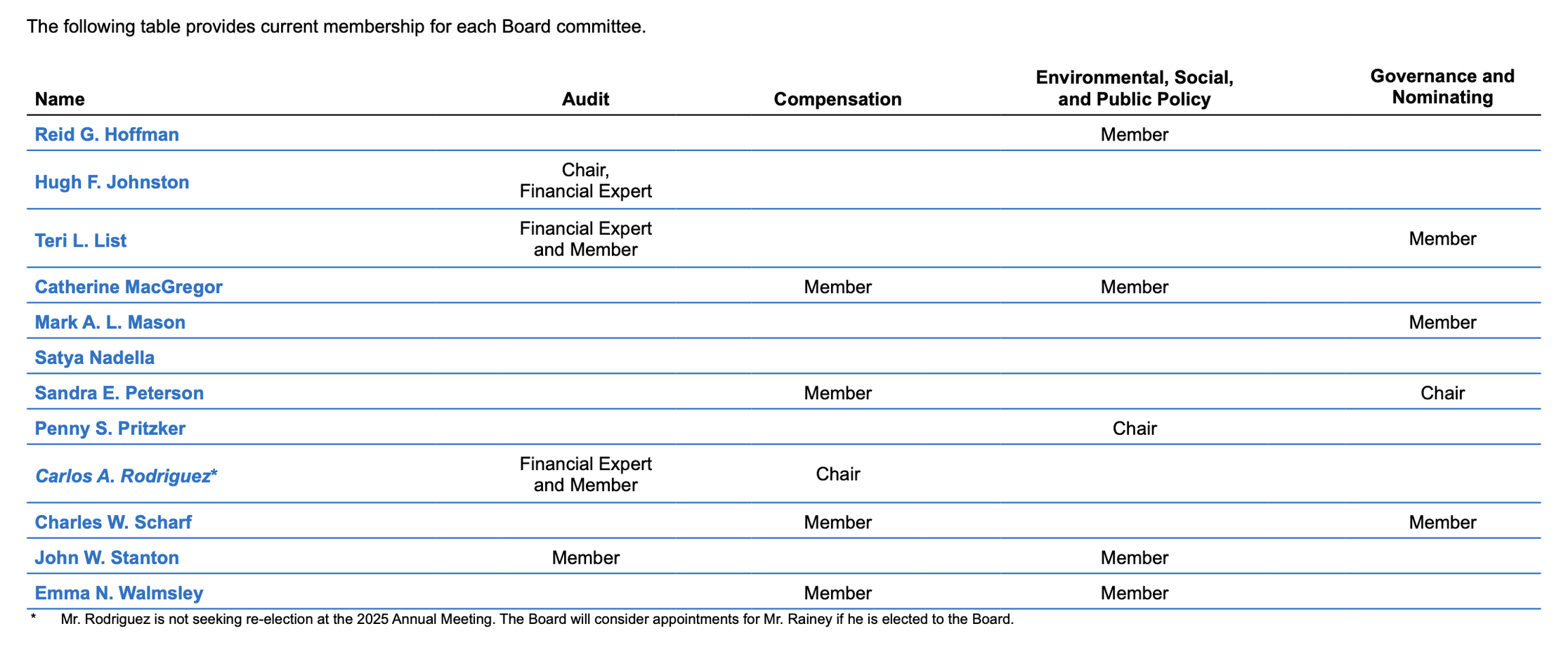
AI sometimes appears to fill the gaps from pre-training data -- newer models accurately return who sits on the board committees at Microsoft, Amazon, Meta or JPMorgan Chase. For smaller listed companies, it might not know or it might invent facts. It can produce a convincing answer, until you realize the people cited are not the right ones.
Standardizing filings for AI agents is the next chapter in a century-old challenge. Publishing information is only part of the job. In many cases, the information is already there. It also needs to reach its readers accurately, including the AI agents reading filings on behalf of investors.
Issuers and filing agents can help by presenting core facts consistently and running their statements through standardized checks before publishing them. Startups could build tools that check whether disclosures can be read reliably before publication. Regulators could extend the standards already in place.
For committee rosters, three things would fix most of it, none of which needs a new rule or regulation but could be done independently by issuers:
- Place text in the cell. Refer to "Member" or "Chair", not a tick image. If the design needs an icon, put the word in the alt attribute of the html tag. Name the committee in full in the header.
- Use a plain table. One header row, one row per director, no merged cells, no spacer images, no section titles spanning the grid. Style it how you like; but the structure underneath should be a table.
- Highlight its place in the filings. Identify an authoritative version of the roster once; every extra copy is a chance for the copies to disagree.
In the financial community, there is a lot of debate about regulating AI. Alongside it, we need to pay attention to practical problems like this one. Knowing who chairs the audit committee should be an easy question for an AI agent to answer.
Explore the code here, including our eval dataset for 27 public filings: github.com/Proxywise-AI/def14a-committee-rosters
Nicolaas Koster is co-founder and CEO of Proxywise AI.